Julia Thecla: Delavan’s Enigmatic Artist of Dreams and Surreal Worlds
For a small Midwestern town, Delavan has produced its share of memorable figures, but few are as intriguing—or as artistically significant—as Julia Thecla, the painter whose dreamlike visions once captivated Chicago’s modern art circles. Born Julia Thecla Connell on February 28, 1896, she grew up as the second‑youngest of five children in Delavan, where her early artistic talent was unmistakable. At just 12 years old, she won first prize in a county drawing contest, a moment that hinted at the imaginative force she would later become.
After graduating from Delavan High School in 1913, Thecla briefly attended Illinois State University in Normal—then a teacher‑training college—before taking a job instructing first through seventh‑grade students in a rural Tazewell County schoolhouse. Teaching was steady work, but it wasn’t her calling. Around 1920, in her early twenties, she made a dramatic break: she moved to Chicago, severed ties with her family and adopted “Thecla” as her surname. She offered different explanations for the change over the years, adding to the air of mystery that would come to surround her.
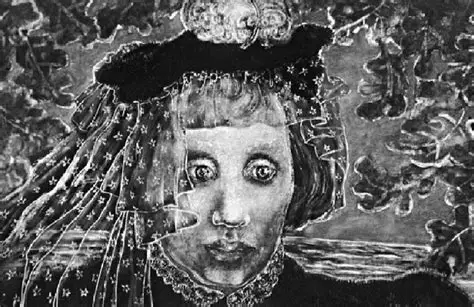
In Chicago, Thecla enrolled at the School of the Art Institute of Chicago, studying for a total of two years while supporting herself with intermittent jobs. Her early artistic development was shaped by the city’s vibrant creative scene, but she forged a path distinctly her own. Working primarily in watercolor, she embraced fantasy, surrealism and magical realism—styles that allowed her to explore the boundaries between the real and the imagined. Critics often described her paintings as “jewel‑like” or “enchanted,” and she frequently used herself as a model, creating intimate, otherworldly scenes centered on the female form.
Her rise in the art world began in 1931, when her work was accepted into the annual International Watercolor Exhibition at the Art Institute of Chicago. She would exhibit there every year through 1936, and again from 1940 to 1944, establishing herself as a consistent and compelling presence in the Midwest’s modern art movement. By the 1940s, her work was being shown nationwide. In 1943, she reached a career milestone when the Museum of Modern Art in New York included her in an exhibition, and that same year she was featured in Peggy Guggenheim’s influential Exhibition by 31 Women at the Art of This Century gallery—an important moment in the recognition of women artists in the United States.
Like many artists of her era, Thecla supplemented her income with practical work. She held jobs as an industrial artist, office worker, and art restorer. Her restoration work, in particular, sharpened her attention to detail—an attribute that became a hallmark of her intricate, fantastical compositions. From 1938 to 1942, she was employed by the Federal Art Project of the Works Progress Administration, contributing to the “easel division” during a period when federal support helped sustain American artists through the Great Depression.
Though best known for her paintings, Thecla also wrote poetry throughout her life. She published only one poem, believing the rest too personal to share. Tragically, most of her manuscripts were lost in 1969 when she was forced to vacate her longtime apartment due to renovation. The move marked the beginning of a difficult final chapter. She stayed with friends and family for a time, but by 1971 she had entered a nursing home, where she remained until her death on June 29, 1973, at age 77.
In the decades following her death, Thecla’s work faded from public memory. Scholars have pointed to several reasons: the mid‑century shift toward abstraction, the chronic underrecognition of women artists and persistent rumors about her mental health—rumors that later researchers have challenged. Yet even as her name slipped from mainstream art history, her paintings endured, quietly preserved in museum collections. As of 2012, the Art Institute of Chicago holds five of her works, though none are on public display, and the Chicago History Museum owns at least one more.
Interest in Thecla has grown in recent years. A 2006 exhibition at the DePaul University Art Museum showcased 35 of her paintings, describing her as a “forgotten Chicago artist” whose ethereal portrayals of dreams, fairytales and imagined worlds offered “extraordinary explorations of alternative social orders.” In 2022, two of her works—including the 1952 piece Amorphous Ones—were featured in a Hirshhorn Museum exhibition highlighting women artists and reexamining the modernist canon.
For Delavan, Julia Thecla remains a hometown figure whose life story bridges rural beginnings and cosmopolitan creativity. Her journey—from a farm‑town childhood to the avant‑garde galleries of New York and Chicago—reflects both the possibilities and the complexities of artistic ambition in the 20th century. Though she left Delavan physically, the town remains an essential part of her narrative: the place where her talent first took root, where she learned to see the world with curiosity and where her story continues to inspire.
Today, as museums and scholars work to restore her place in American art history, Delavan can take pride in remembering Julia Thecla not as a forgotten figure, but as a visionary whose imagination carried her far beyond the prairie—and whose legacy is finally being rediscovered.
