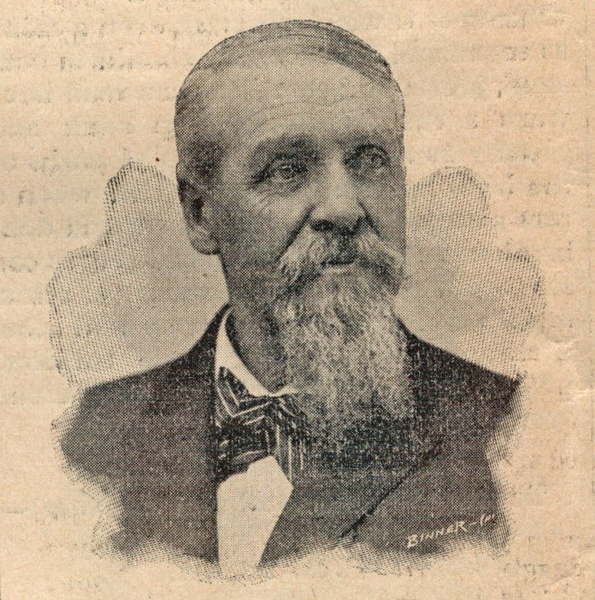
Henry H. “H.H.” Cole
The Traveling New Yorker Who Captured Tazewell County’s Early Faces
Long before smartphones made snapshots effortless, a young man from rural New York arrived in Illinois with a new and astonishing skill: the ability to trap a moment of life on a small, shining plate. His name was Henry Hobart Cole, better known to generations of Taze-well County families as H.H. Cole, the region’s pioneer photographer. Born July 24, 1833, in Gilbertsville, Otsego County, New York, Cole would go on to shape how Central Illinois remembers its earliest settlers—one portrait at a time.
Cole grew up the youngest of ten children in a household where curiosity and craft ran deep. In New York, he and his older brother Roderick learned the delicate, demanding art of the Daguerreotype, the earliest successful photographic process. When the brothers moved west to Illinois in 1850, Henry was just 17—young, ambitious, and already skilled in a trade most Americans had never seen.
Roderick opened a studio in Peoria, and Henry worked at his side. But the younger Cole quickly proved he had both the talent and the drive to strike out on his own. By 1851, he opened “Cole’s Fine Art and Photographic Gallery” in Peoria, launching a friendly but real rivalry with his brother. The competition ended in 1859, when Henry bought out Roderick’s business and became one of the region’s most sought‑after photographers.
Cole’s career intersected with some of the most iconic figures of the 19th century. In 1858, during the Lincoln‑Douglas debates, he photographed a beardless Abraham Lincoln—a portrait that would later become one of the most historically significant images of the future president. Both Henry and Roderick claimed credit for the photograph, and given their working relationship at the time, historians believe both may have played a role.
Cole admired Lincoln deeply. According to the 1949 Pekin Centenary, he attended the 1860 Republican National Convention in Chicago and returned home without his silk hat—lost in the wild celebration that followed Lincoln’s nomination.
He also crossed paths with the famed orator Robert Ingersoll, with whom he briefly roomed. A previously unknown 1876 portrait of Ingersoll, taken by Cole, surfaced as recently as 2007, underscoring the breadth of his work and the longevity of his legacy.
Cole’s Peoria studio at Main and Washington burned in 1861, destroying years of work. But he rebuilt quickly, relocating to Adams Street and investing in new photographic technologies. He traveled to Chicago to learn the Ferrotype (tin‑type) process—paying $50, a significant sum at the time—to ensure he remained at the forefront of his craft.
By 1879, Cole expanded his business to Pekin, where he established what would become his most enduring studio. From there, he also operated in Delavan, offering portraits, family photographs, and images of local businesses, farms, and civic leaders. His Delavan presence helped document the town during a period of rapid growth, capturing faces and streetscapes that would otherwise have been lost to time.
Cole’s most ambitious project began in the late 19th century: a Historical Picture Gallery of more than 1,000 portraits of Tazewell County pioneers, displayed for decades in the hallway of the Tazewell County Courthouse. The collection included farmers, merchants, judges and everyday families—an unparalleled visual record of the county’s early residents.
Many of these images were later discovered in storage and painstakingly digitized by volunteers, preserving Cole’s work for future generations. Today, his photographs remain some of the most valuable historical artifacts in Central Illinois, offering a rare window into the people who built the communities we now call home.
Henry H. Cole was more than a photographer. He was a chronicler of frontier life, a craftsman who understood that every face told a story worth saving. From his New York beginnings to his studios in Peoria, Pekin, and Delavan, Cole left behind a legacy measured not in buildings or businesses, but in the thousands of lives he captured—each one a testament to the early spirit of Tazewell County.
His work endures, reminding us that history is not only written in words, but also illuminated in the quiet, steady gaze of those photographers who came before us.
