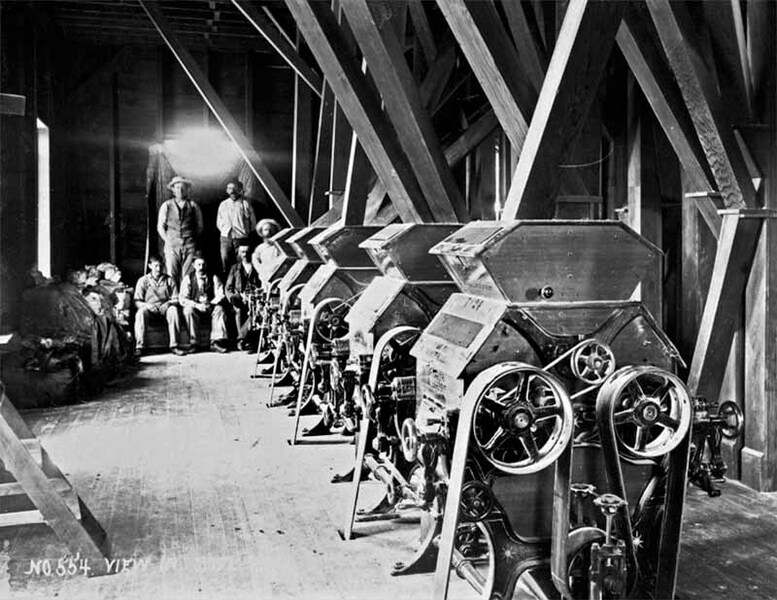
From Steam to Success: How Delavan Became an International Flour Milling Hub
Long before grain elevators dotted the prairie skyline, Delavan’s earliest entrepreneurs were already trying to turn the region’s rich farmland into a thriving milling industry. Their efforts—some bold, some costly, all ambitious—laid the groundwork for a chapter of local history that would eventually send Central Illinois flour across the globe.
The town’s first attempt came in 1839, when Deacon Henry R. Green established a steam-powered custom mill. It was a forward-looking venture for a frontier community still finding its footing. A second effort followed in 1861, when John L. Orndorff opened another mill. That project proved far more painful: Orndorff reportedly lost $10,000, a staggering sum for the era.
Despite these early setbacks, the idea of Delavan as a milling center never fully disappeared. It simply needed the right combination of timing, technology, and tenacity.
That moment arrived 29 years after Deacon Green’s first mill, when Frederick Starz, along with partners Fred Lehman and Arthur Stubbs, founded the Delavan City Mills in 1868. Their operation marked a turning point—not just for the town’s economy, but for its identity.
The Delavan City Mills blended locally grown wheat with western hard wheat, producing a high-quality flour that quickly found buyers far beyond Illinois. With a capacity of 100 barrels per day, the mill shipped its product to England, Ireland, Scotland, and even Cuba, placing Delavan on an international map few small towns could claim.
Success bred expansion. In 1870, just two years later, a second major operation opened: the Young America Mills, launched by Arthur Stubbs and John B. Starz, Frederick’s son. With a daily capacity of 150 barrels, it surpassed its predecessor and solidified Delavan’s reputation as a regional milling powerhouse.
For a time, the rhythmic hum of grinding stones and steam engines became part of the town’s soundtrack. Farmers brought in wagonloads of wheat. Railcars carried out barrels of flour stamped with Delavan’s name. And a community that once struggled to sustain a single mill found itself home to two flourishing enterprises.
Today, the mills are gone, but their legacy remains woven into Delavan’s story—a reminder of the persistence, partnership, and quiet ambition that helped shape the town’s early economy. In the span of just a few decades, Delavan went from hopeful experiments to global exports, proving once again that even small towns can leave a wide footprint when opportunity meets determination. interested in this option are encouraged to reach out for further discussion.
